A common misconception among Stewards fresh off of training or reading a Grievance Guide is they begin citing Arbitrations in their Grievances. While this can present a plethora of issues (Award not matching Opinion, Case not matching Award, etc) in and of itself, we are ignoring the most basic issue when citing Regional Arbitrations – the value.
Direct Value
A document with Direct Value is one that is binding, germane, and specific to your situation or Grievance. Think of a Precedent Setting Arbitration for your Facility. If you have a Precedent Setting Arbitration that deals with your situation specifically it has a Direct Value to the Grievance and should be cited as binding.
Their is no need to relitigate, negotiate or discuss as the issue has been decided upon. The CBA, the JCIM, Step 4’s, and other such items should be treated with Direct Value.
If Management violates a document with Direct Value you can, and should, file a Grievance over that matter specifically either as an Article 19 violation or as a compliance Grievance.
Example: Then Industrial Relations Director Tony D. McKinnon Sr. signed a Step 4 agreement on August 24th, 2016 which defined ‘normal staffing’ on the DBCS Machine as two employees. This is binding and should be cited as if it were a part of the Collective Bargaining Agreement.
Persuasive Value
A document with Persuasive Value (Often called Precedential Value) is a Settlement, MOU, Service Talk or other such item which is not binding, germane or specific to your situation or Grievance but can be used to convince or sway an Arbitrator.
The Arbitrator can disagree, but should give the Persuasive item value and consideration. You will commonly see Persuasive Value items such as Regional Arbitration Awards and Awards from other Unions (Such as the NALC).
Persuasive Example
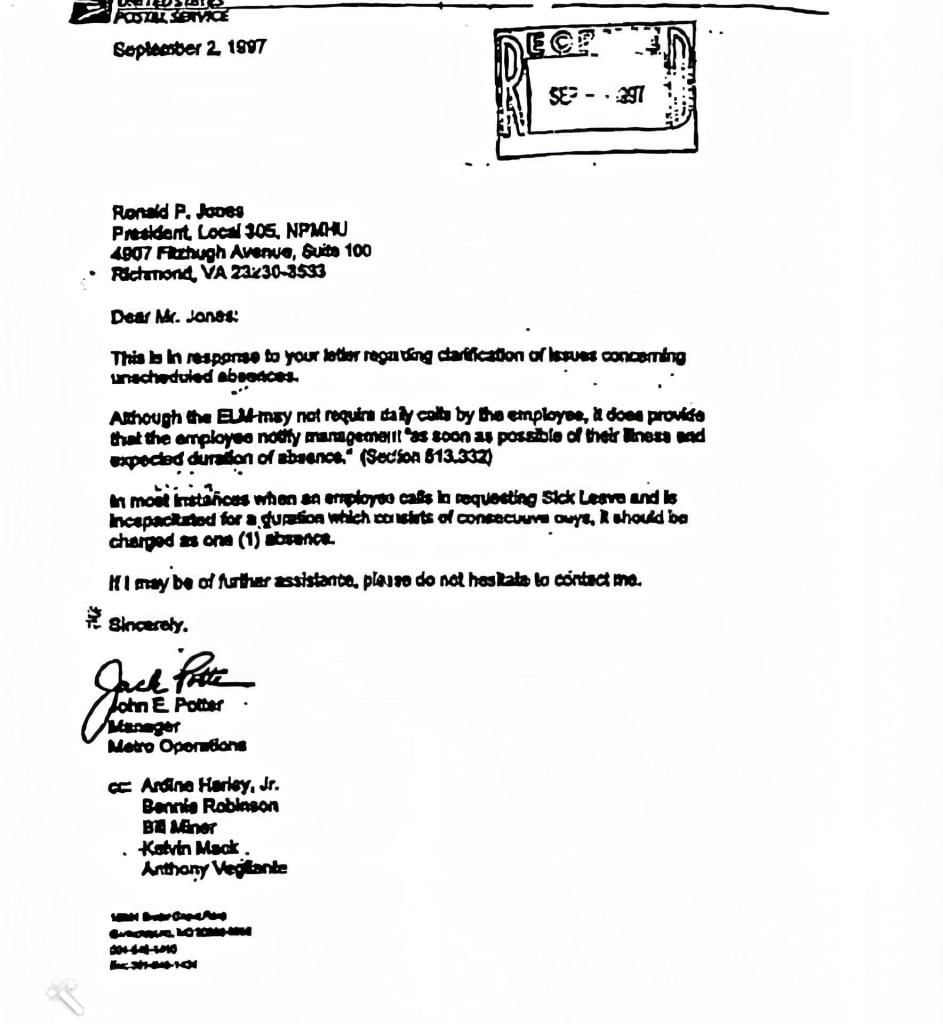
The above is a letter from former Postmaster General Potter to NPMHU Local 305. This letter states that when employees request Sick Leave where an employee is incapacitated which consists of consecutive days shall be treated as one absence.
This means means that if you call into work on 8-14; 8-15, and 8-16 due to being incapacitated those absences should be treated as one occurrence.
This is not Direct but Persuasive for a few reasons:
- This was sent to another Union (NPMHU)
- PMG Potter was not PMG yet – has was acting as a Manager
- This letter is specific to the facility in Virginia
- The ELM has changed since this was issued
The issue should be clear – this is not an Official USPS / APWU policy. It was not made by an individual with the authority to make a decision. The letter addresses a local leave policy and not a National policy. Finally, this is nearly 20 years old and several changes to the relevant ELM provisions have occurred.
You CANNOT rely on a Persuasive item to win your Grievance!
How to Use a Persuasive Document
In Arbitration, you would provide a Persuasive Arbitration to Management during your closing. I commonly do not recommend Stewards to cite such Arbitrations in their Grievance because it acts as a crutch – you need to prove your violation independently of the Persuasive Documentation.
If you do choose to cite such a Document such as an Arbitration from another region, or the letter above, you must use it as an Argument in your Grievance.
Your Step 2 would be written something like this:
“The Union Contends that Management violated Article 16 of the JCIM which states, ‘The requirement that discipline be corrective rather than punitive is an essential element of the “just cause” principle.’ The Union argues that Management deliberately listed all dates individually on the issued discipline to give the illusion that the Grievants record is more severe than it actually is in order to justify disciplinary action.
The Union further argues that not only should the occurrences be grouped together, sequential absences should have been scheduled and not counted as Unscheduled Absences. Management was made aware on August 13th, in advance, that the Grievant would not be able to report to work on August 14th, 15th and 16th. Management had the ability, and obligation to attempt to replace the Grievant if needed by calling overtime, having a PSE report to the facility, etc. The decision to mark the absences after August 14th as Unscheduled is by definition Punitive as the Grievant was suffering from the same illness on all dates in question and Management had advanced notice.
Finally, the Union argues this position is consistent with the opinion of former PMG Potter. As Manager, Potter penned Exhibit – Potter Letter which clearly states such absences should be cited as one occurrence. The Union asserts while this is not a binding position, the opinion and interpretation of a former Postmaster General must be given appropriate weight as the one time figurehead of the USPS affirmed the Unions interpretation.”
Again, the above Step 2 example is not using the Potter Letter as a binding document. It is using it to support the Unions position and to be persuasive to the Management Official reading it. You do not cite it as a direct violation, but list it as a supporting argument.
Your Takeaway
If you review most training guides you will find citations of Step 3 Grievances that support the Unions opinion and position. These Grievances have value, but if they are from other Regions, have differing details, etc they cannot be used as a smoking gun in your Grievance.
You can use them to prop up another argument you make. Your National Business Agents and Arbitration Advocates should already be providing Arbitrations with Persuasive Value to the Arbitrator as needed.
I must recommend caution, as outlined in the UnOfficial Grievance Guide. You have several pitfalls in citing Step 3 Decisions or Arbitrations when you do not have access to the full Award or Case File. If you don’t believe me, look into Management’s cited Arbitration for ‘undue enrichment’ and the series of Grievances that followed. The Award hurt the Union, but the Opinion supported the Unions position (If I recall correctly). If you mis – cite an Award it absolutely can backfire.
 APWU Steward
Leave a comment